Gen Z’s Career Path: 5 High-Growth Industries for 2026
Anúncios
By 2026, Gen Z’s career path will increasingly converge with five rapidly emerging industries: sustainable technology, artificial intelligence, digital health, immersive experiences, and personalized education, offering unparalleled growth and innovation opportunities.
Are you part of Gen Z, looking ahead to a career that not only offers stability but also significant growth potential? The landscape of work is changing rapidly, and understanding where the opportunities lie is crucial. This article delves into Gen Z’s career path, highlighting five emerging industries poised for substantial growth by 2026, offering exciting prospects for the next generation of professionals.
Anúncios
The Rise of Sustainable Technology and Green Careers
The urgency of climate change and environmental degradation has propelled sustainable technology into a leading position for future job growth. Gen Z, often characterized by a strong sense of social responsibility and environmental consciousness, is naturally drawn to careers that make a positive impact. This sector encompasses a wide array of innovations aimed at reducing carbon footprints, conserving resources, and developing renewable energy sources.
From solar panel engineers to urban farm designers, the demand for skilled professionals in green industries is skyrocketing. Companies are investing heavily in sustainable practices, creating new roles that require a blend of technical expertise and environmental passion. This isn’t just about traditional environmental science; it’s about applying cutting-edge technology to solve ecological problems.
Innovation in Renewable Energy
Renewable energy sources like solar, wind, and geothermal power are at the forefront of the sustainable technology movement. As the world shifts away from fossil fuels, the need for experts in these fields will only intensify. This includes not only the development and installation of new energy systems but also their maintenance and optimization.
Anúncios
- Solar Energy Technicians: Install and maintain solar panels for residential and commercial properties.
- Wind Turbine Engineers: Design, develop, and oversee the construction of wind farms.
- Battery Storage Specialists: Focus on advancing energy storage solutions for renewable grids.
Circular Economy and Waste Management
The concept of a circular economy, where waste is minimized and resources are reused, is gaining traction. This involves designing products for longevity, recycling materials, and creating closed-loop systems. Gen Z professionals can find fulfilling careers in reimagining production processes and consumption patterns.
This area requires creative problem-solvers who can develop innovative ways to reduce waste and promote resource efficiency. It’s a holistic approach that impacts every stage of a product’s lifecycle, from design to disposal.
In conclusion, the sustainable technology sector offers a dynamic and impactful career path for Gen Z. It’s a field where innovation meets purpose, providing opportunities to contribute to a healthier planet while building a robust professional future. The growth in this area is not just a trend but a fundamental shift in how industries operate globally.
Artificial Intelligence and Machine Learning: The Future is Now
Artificial Intelligence (AI) and Machine Learning (ML) are no longer futuristic concepts; they are integral to modern society and are profoundly shaping Gen Z’s career path. These technologies are revolutionizing industries from healthcare to finance, creating a vast demand for professionals who can develop, implement, and manage AI systems. Gen Z, being digital natives, are well-positioned to thrive in this rapidly evolving field.
The growth in AI and ML is driven by the increasing availability of data and the need for automation and intelligent decision-making. Companies are constantly seeking ways to leverage AI to improve efficiency, personalize customer experiences, and unlock new business opportunities. This translates into a wide range of job roles, from data scientists to AI ethics specialists.
Data Science and Analytics
At the heart of AI and ML lies data. Data scientists are crucial for collecting, analyzing, and interpreting complex datasets, providing the insights needed to train AI models. This role requires strong analytical skills and a deep understanding of statistical methods.
- Data Scientists: Extract insights from data, build predictive models.
- Machine Learning Engineers: Design and build ML systems and algorithms.
- AI Ethicists: Ensure AI systems are developed and used responsibly and fairly.
Natural Language Processing (NLP) and Computer Vision
Subfields of AI, such as Natural Language Processing (NLP) and Computer Vision, are also experiencing explosive growth. NLP deals with enabling computers to understand and process human language, while Computer Vision allows machines to interpret and understand visual information from the world. These areas are critical for applications like virtual assistants, autonomous vehicles, and facial recognition.
These specializations require a blend of programming skills, mathematical understanding, and a keen eye for detail. As AI becomes more sophisticated, the demand for experts in these niche areas will continue to rise, offering exciting challenges and opportunities for Gen Z professionals.
In summary, AI and ML present a boundless frontier for Gen Z’s career development. The ability to work with and understand these technologies will be a cornerstone of success in the coming years, offering roles that are both intellectually stimulating and financially rewarding across diverse sectors.
Digital Health and Telemedicine: Revolutionizing Healthcare
The healthcare industry is undergoing a significant transformation, with digital health and telemedicine emerging as critical components. Driven by technological advancements and the need for more accessible and efficient care, this sector offers a wealth of opportunities for Gen Z. From remote patient monitoring to AI-powered diagnostics, digital health is reshaping how medical services are delivered.
Gen Z, having grown up with technology, is uniquely equipped to contribute to this revolution. The pandemic significantly accelerated the adoption of telemedicine, demonstrating its potential to provide care regardless of geographical barriers. This shift has created new demands for professionals skilled in health informatics, digital platform development, and patient engagement through technology.
Telehealth Platform Development
Developing and maintaining robust telehealth platforms is central to this industry’s growth. This includes creating user-friendly interfaces for patients and providers, ensuring data security and privacy, and integrating with existing healthcare systems. Software developers and UX/UI designers with a focus on healthcare are in high demand.
- Health Informatics Specialists: Manage and analyze health data.
- Telemedicine Software Engineers: Develop and maintain virtual care platforms.
- Digital Health Product Managers: Oversee the development of new digital health solutions.
Personalized Medicine and Wearable Technology
Personalized medicine, enabled by genetic sequencing and data analytics, is allowing for more tailored treatments. Alongside this, wearable technology is empowering individuals to monitor their health proactively. Gen Z can find roles in developing these technologies, interpreting the data they generate, and integrating them into comprehensive care plans.
These advancements require professionals who can bridge the gap between technology and medical science. The focus is on creating solutions that are not only technologically advanced but also clinically effective and patient-centric. This sector promises to be a cornerstone of future healthcare delivery.
Ultimately, digital health and telemedicine offer Gen Z a chance to make a profound difference in people’s lives through technological innovation. It’s a field that demands both technical prowess and a compassionate understanding of human health needs, making it a highly rewarding career choice.
Immersive Experiences: Metaverse and Extended Reality
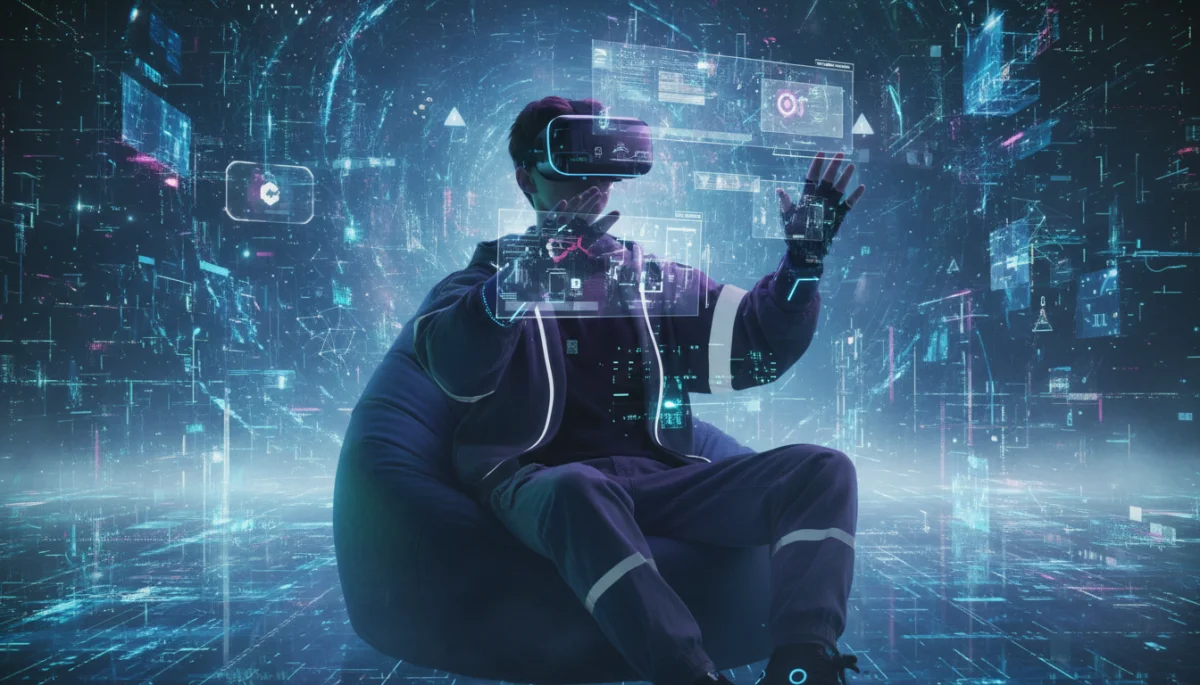
The realm of immersive experiences, encompassing the metaverse, virtual reality (VR), augmented reality (AR), and mixed reality (MR), is rapidly expanding and represents another significant area for Gen Z’s career path. These technologies are transforming entertainment, education, training, and even social interaction, creating a demand for creators, developers, and strategists who can build these new digital worlds.
Gen Z, having grown up with sophisticated digital interfaces and online gaming, possesses an intuitive understanding of virtual environments. This natural affinity gives them a distinct advantage in a field that requires creativity, technical skill, and a vision for future digital interaction. The potential applications of immersive experiences are vast, extending far beyond gaming into practical, everyday uses.
Metaverse Development and Design
The concept of the metaverse, a persistent, interconnected virtual world, is driving significant investment and innovation. Building these complex environments requires a diverse set of skills, from 3D modeling and animation to backend infrastructure development and user experience design. The metaverse promises to be a new frontier for commerce, social connection, and creative expression.
- VR/AR Developers: Create immersive applications and experiences.
- 3D Artists and Animators: Design virtual assets and environments.
- Spatial Computing Engineers: Work on the underlying technology for immersive platforms.
Interactive Content Creation
Beyond technical development, there’s a growing need for professionals who can create engaging and meaningful content for immersive platforms. This includes storytelling in VR, designing interactive learning modules in AR, and developing new forms of digital entertainment. The blend of creativity and technology is paramount here.
This field is not just about coding; it’s about imagining and building entirely new realities. Gen Z professionals can leverage their digital fluency and creative instincts to shape the future of how we interact with information and each other. The opportunities are as limitless as the imagination.
In essence, immersive experiences offer Gen Z a chance to be pioneers in a burgeoning digital landscape. It’s a field that combines artistic vision with technical execution, promising a future filled with innovative projects and groundbreaking achievements.
Personalized Education and EdTech Innovation
The education sector is undergoing a profound transformation, driven by technology and a growing demand for personalized learning experiences. EdTech (Educational Technology) innovation, particularly in personalized education, offers a fertile ground for Gen Z’s career path. This industry focuses on leveraging technology to tailor learning content, delivery methods, and assessments to individual student needs and preferences.
Traditional one-size-fits-all education models are becoming obsolete. Gen Z, having experienced diverse learning environments, understands the value of customized approaches. The push towards hybrid learning, online platforms, and adaptive learning systems has created a significant need for professionals who can design, develop, and implement these innovative educational solutions.
Adaptive Learning Systems Development
Adaptive learning systems use AI and data analytics to adjust educational content and pace based on a student’s progress and learning style. Developing these sophisticated platforms requires expertise in software engineering, instructional design, and cognitive science. The goal is to create highly effective and engaging learning journeys.
- Instructional Designers: Create engaging and effective learning content.
- EdTech Software Developers: Build and maintain educational platforms.
- Learning Analytics Specialists: Analyze student data to improve learning outcomes.
Virtual Tutors and AI-Powered Assessment
AI is also being used to create virtual tutors that can provide individualized support and AI-powered assessment tools that offer immediate feedback. These innovations aim to enhance learning efficiency and provide educators with valuable insights. Gen Z can contribute by developing these tools or by becoming expert users and facilitators of these new educational technologies.
This sector is not just about technology; it’s about reimagining how knowledge is acquired and shared. It requires professionals who are passionate about education and eager to leverage technology to unlock every student’s full potential. The impact of personalized education will be transformative for future generations.
To conclude, personalized education and EdTech innovation provide Gen Z with a unique opportunity to shape the future of learning. It’s a field where technological prowess can directly translate into empowering individuals and fostering a more effective and equitable educational landscape.
Future-Proofing Your Skills for 2026 and Beyond
As Gen Z navigates their career path towards 2026 and beyond, understanding the skills that will be most in-demand is paramount. The rapidly evolving job market requires continuous learning and adaptability. While specific technical skills are crucial for each emerging industry, a set of foundational competencies will serve as a bedrock for success across all sectors. These include critical thinking, problem-solving, and digital literacy, which are increasingly vital in an automated world.
The ability to collaborate effectively in diverse, often remote, teams is also becoming a non-negotiable skill. Gen Z, with their inherent digital fluency, often possesses a head start in this area, but refining communication and teamwork skills remains essential. The future workforce will value individuals who can not only perform tasks but also innovate, adapt, and lead in dynamic environments.
Essential Soft Skills for the Modern Workforce
Beyond technical expertise, soft skills are often the differentiators that propel careers forward. Employers are increasingly looking for candidates who can demonstrate emotional intelligence, resilience, and a proactive approach to learning. These attributes enable individuals to navigate complex challenges and adapt to new technologies and methodologies.
- Critical Thinking: Analyzing information objectively and making reasoned judgments.
- Adaptability and Flexibility: Embracing change and adjusting to new situations.
- Creativity and Innovation: Developing novel solutions and ideas.
- Complex Problem-Solving: Tackling intricate issues with strategic approaches.
Continuous Learning and Upskilling
The pace of technological change means that skills acquired today may become obsolete tomorrow. Therefore, a commitment to continuous learning and upskilling is not just an advantage but a necessity. Gen Z should actively seek out opportunities for professional development, whether through online courses, certifications, or mentorship programs.
Embracing a growth mindset, where challenges are seen as opportunities for learning, will be crucial for long-term career success. This involves staying curious, exploring new tools and technologies, and actively seeking feedback to improve. Investing in oneself through education and skill development is the ultimate form of career future-proofing.
In essence, future-proofing your skills means cultivating a blend of technical proficiency and robust soft skills, coupled with an unwavering commitment to lifelong learning. For Gen Z, this holistic approach will unlock countless opportunities in the emerging industries of 2026 and beyond, ensuring a dynamic and fulfilling professional journey.
| Key Industry | Growth Potential & Gen Z Relevance |
|---|---|
| Sustainable Technology | High demand for green jobs, aligning with Gen Z’s environmental values. Focus on renewable energy, circular economy. |
| AI & Machine Learning | Revolutionizing all sectors; Gen Z’s digital native skills are critical for data science, NLP, and computer vision roles. |
| Digital Health & Telemedicine | Transforming healthcare delivery; Gen Z can drive innovation in telehealth platforms and personalized medicine. |
| Immersive Experiences | Metaverse, VR, AR creating new frontiers in entertainment, education, and social interaction, ideal for digitally fluent Gen Z. |
Frequently Asked Questions About Gen Z Careers
Gen Z should prioritize developing critical thinking, problem-solving, adaptability, and digital literacy. These foundational soft skills are essential across all emerging industries and will enable them to navigate rapid technological advancements and evolving job markets effectively.
To prepare for sustainable technology jobs, Gen Z should focus on STEM education, particularly in engineering, environmental science, and data analytics. Gaining practical experience through internships in renewable energy or circular economy projects is also highly beneficial.
While a traditional degree can be valuable, many emerging industries also highly value specialized certifications, bootcamps, and demonstrable project portfolios. Continuous learning and practical skills often outweigh formal degrees, especially in fast-evolving fields like AI and immersive experiences.
Remote and hybrid work models are expected to remain prevalent, offering Gen Z greater flexibility and access to global opportunities. Developing strong self-management, communication, and digital collaboration skills will be crucial for success in these distributed work environments.
Gen Z can seek mentorship through professional networking events, online communities specific to their chosen industry, and platforms like LinkedIn. Actively engaging with professionals and expressing genuine interest in their work can often lead to valuable mentorship relationships.
Conclusion
As Gen Z steps into the workforce, the opportunities presented by emerging industries are not just trends but fundamental shifts shaping the future of work. From the imperative of sustainable technology to the boundless potential of AI, digital health, immersive experiences, and personalized education, these sectors offer dynamic and impactful career paths. By cultivating essential skills, embracing continuous learning, and aligning their passions with these high-growth areas, Gen Z can confidently navigate their professional journey, contributing to innovation and building fulfilling careers that are both relevant and resilient in the years leading up to 2026 and beyond.
