Apprenticeships vs. Traditional Degrees: 2026 Cost-Benefit Analysis for Trades
Anúncios
This analysis dissects the 2026 landscape of apprenticeships versus traditional degrees, offering a clear cost-benefit perspective for individuals pursuing careers in skilled trades, emphasizing financial returns and long-term career viability.
Anúncios
As we navigate the complexities of the 2026 job market, understanding the best path for career development is more crucial than ever. For those eyeing skilled professions, a detailed look at apprenticeships vs. traditional degrees offers valuable insights into financial implications, career readiness, and long-term success in the trades.
The evolving landscape of career preparation in 2026
The year 2026 presents a dynamic and often perplexing environment for individuals deciding on their post-secondary education and career trajectories. Traditional four-year degrees, once considered the gold standard for upward mobility, are increasingly being re-evaluated against alternative pathways, especially within the skilled trades. The economic shifts, technological advancements, and changing employer demands have significantly altered what constitutes a ‘valuable’ education.
This re-evaluation is not merely academic; it’s driven by tangible factors such as student loan debt, the demand for specific skills, and the immediate earning potential offered by different educational routes. Both apprenticeships and traditional degrees offer distinct advantages, but their suitability largely depends on individual aspirations, financial situations, and preferred learning styles. Understanding these nuances is key to making an informed decision in today’s competitive landscape.
Anúncios
The traditional degree: enduring value and new challenges
Traditional degrees continue to hold significant prestige and open doors to many professional careers. Universities offer a broad education, fostering critical thinking, research skills, and a comprehensive understanding of various disciplines. However, the rising cost of tuition and the increasing burden of student debt are undeniable challenges.
- High upfront costs: Tuition, fees, housing, and living expenses can accumulate rapidly.
- Delayed entry into workforce: Four or more years of full-time study before professional employment.
- Broad skill development: Focus on theoretical knowledge and general competencies.
- Networking opportunities: Access to alumni networks and career services.
Apprenticeships: hands-on learning for immediate impact
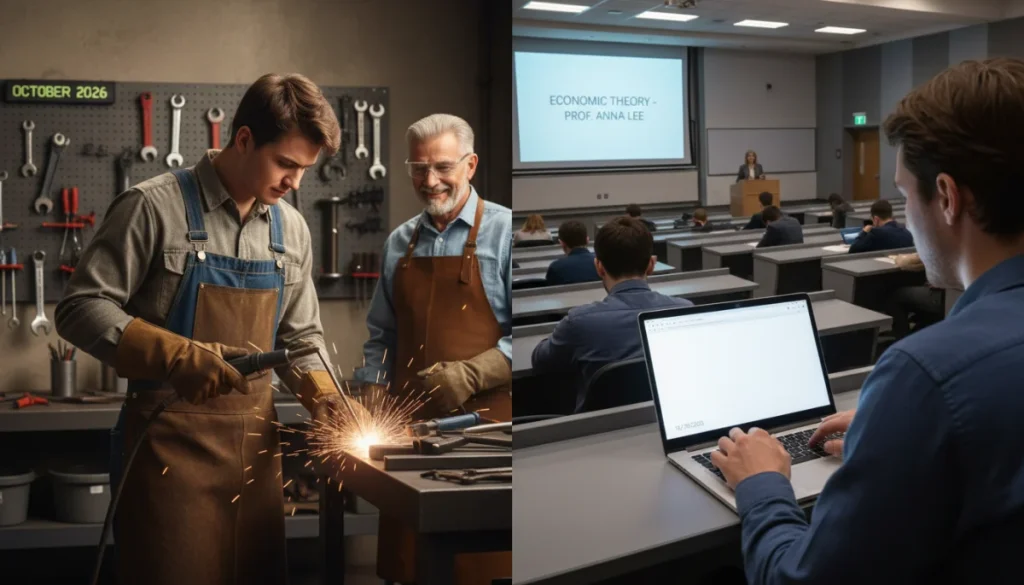
Apprenticeships, conversely, offer a direct route into a skilled trade, combining on-the-job training with related classroom instruction. This model allows individuals to earn wages while learning, often resulting in little to no student debt. The focus is intensely practical, preparing apprentices with job-specific skills highly valued by employers.
The conclusion here is that while traditional degrees offer a wide array of opportunities and intellectual growth, their financial and time commitments are substantial. Apprenticeships provide a more direct, debt-free path into specific skilled professions with immediate earning potential, addressing the urgent demand for skilled labor in various industries.
Financial implications: costs and returns for both paths
One of the most critical factors in choosing between an apprenticeship and a traditional degree is the financial aspect. This includes not only the direct costs of education but also the opportunity cost of lost earnings and the potential return on investment (ROI) over a career lifetime. In 2026, these financial considerations have become even more pronounced, with inflation and economic uncertainties influencing long-term planning.
Evaluating the financial implications requires a holistic view, considering both the short-term expenditures and the long-term earning potential. What might seem cheaper initially may not always yield the best financial outcome over several decades, and vice versa. It’s about aligning financial commitment with career goals and personal circumstances.
Cost analysis: tuition, fees, and living expenses
The cost disparity between traditional degrees and apprenticeships is often stark. A four-year bachelor’s degree at a public university can easily exceed $100,000, and private institutions can be significantly higher, not including living expenses. These costs frequently necessitate student loans, which can become a lifelong burden.
- Traditional degree costs: Average public university tuition and fees (in-state) around $10,740 per year, private around $38,070 per year (2026 estimates).
- Apprenticeship costs: Often minimal, sometimes even free, as employers or unions cover training costs. Apprentices typically earn wages.
- Living expenses: A factor for both, but apprentices often earn enough to cover these, reducing reliance on loans.
Earning potential: immediate and long-term outlook
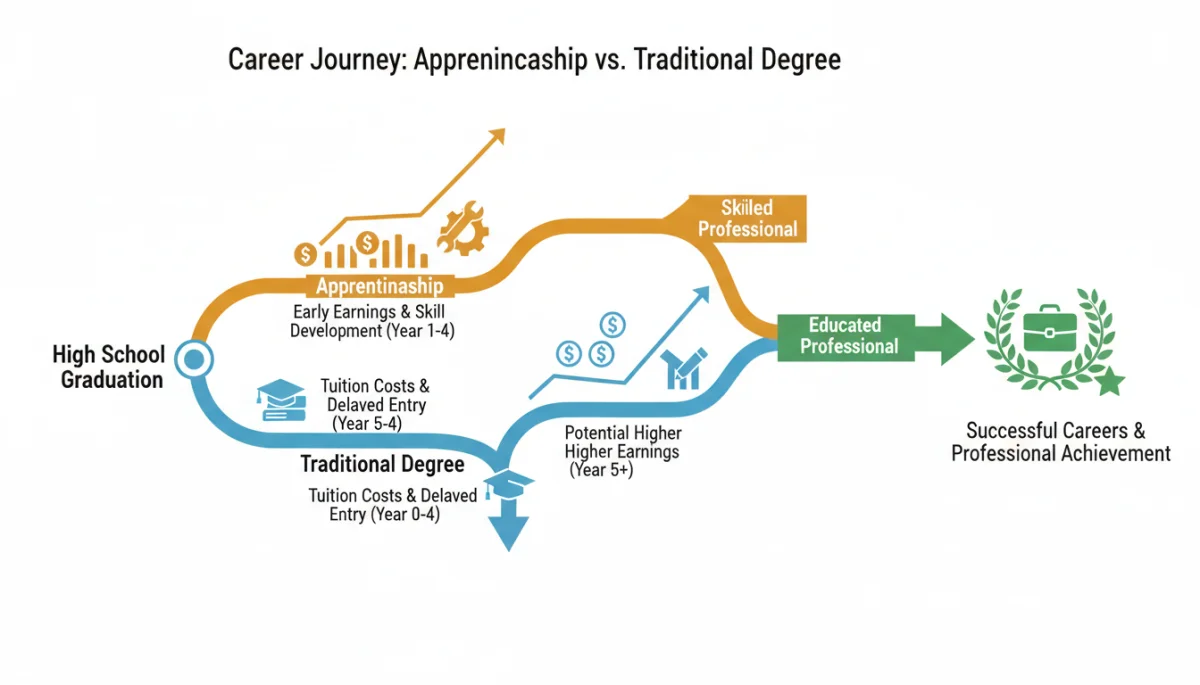
The immediate earning potential heavily favors apprenticeships. Apprentices typically start earning a wage from day one, which increases as they progress through their training. Upon completion, they enter the workforce as skilled professionals, often with competitive salaries and benefits.
While traditional degree holders might face a period of unemployment or underemployment post-graduation, their long-term earning potential can be higher in certain fields. However, this is not universally true, especially when comparing a highly skilled trade with a general liberal arts degree. Many trades offer excellent long-term earning prospects, often surpassing those of some degree-holding professions, especially considering the absence of student loan debt.
In conclusion, the financial pathway of an apprenticeship generally involves lower initial costs and earlier earning, leading to less debt. Traditional degrees, while potentially offering higher peak earnings in specific sectors, come with substantial upfront investment and the risk of significant student loan debt, which can impact financial freedom for years.
Skill development and career readiness in 2026
The efficacy of any educational path is ultimately measured by its ability to equip individuals with the skills necessary for success in their chosen careers. In 2026, with rapid technological advancements and evolving industry demands, the relevance and practical application of acquired skills are paramount. Both apprenticeships and traditional degrees aim to develop skills, but they do so through fundamentally different pedagogical approaches.
Understanding these differences is crucial for prospective students to choose a path that aligns with their learning style and career aspirations. The ‘readiness’ factor – how quickly an individual can become a productive member of the workforce – also plays a significant role in the overall cost-benefit analysis.
Hands-on training vs. theoretical knowledge
Apprenticeships are inherently hands-on. They immerse individuals directly into the work environment, allowing them to learn by doing under the guidance of experienced professionals. This practical approach ensures that skills are directly applicable to the job, fostering immediate competency and confidence.
- Apprenticeship focus: Practical application, problem-solving in real-world scenarios, mastery of specific tools and techniques.
- Traditional degree focus: Conceptual understanding, analytical thinking, research methodologies, broad intellectual development.
- Skill transferability: Apprenticeships build specialized skills; degrees often cultivate more general, transferable skills, though specific degree programs can also be highly specialized.
Industry relevance and employer demand
Apprenticeship programs are often designed in direct collaboration with industry partners, ensuring that the skills taught are precisely what employers need right now. This direct alignment with market demand often translates into high employment rates for graduates. Many apprentices are even hired by the companies that trained them.
Traditional degrees, while offering a broader foundation, sometimes face challenges in aligning curriculum with the rapid pace of industry change. While a degree can provide a strong theoretical base, new graduates may still require significant on-the-job training to adapt to specific workplace demands. However, certain degree fields, particularly in STEM, maintain strong industry relevance and demand.
Ultimately, the choice between these two paths for skill development depends on whether an individual prefers an immersive, practical learning experience with immediate job relevance (apprentice) or a broader, more theoretical education that cultivates critical thinking and opens diverse career avenues (traditional degree). Both can lead to successful careers, but the journey and the skills acquired differ significantly.
Flexibility and adaptability in the modern workforce
The 2026 workforce demands not only specialized skills but also a high degree of flexibility and adaptability. Economic shifts, technological innovations, and evolving societal needs mean that career paths are rarely linear. The ability to pivot, learn new skills, and adjust to changing environments is crucial for long-term career resilience. Both apprenticeships and traditional degrees offer different avenues for developing these qualities, each with its unique strengths and limitations.
Considering how each pathway prepares individuals for unforeseen changes and continuous learning is an important part of a comprehensive cost-benefit analysis. A robust career strategy in 2026 involves more than just initial entry; it requires foresight into future growth and potential transitions.
Career mobility and advancement opportunities
Traditional degrees are often perceived as providing greater career mobility due to the breadth of knowledge acquired. A bachelor’s degree can serve as a prerequisite for various advanced degrees or managerial positions across different industries. While this can be true, specialized degrees can also lead to highly focused career paths.
Apprenticeships, while specializing in a specific trade, also offer significant advancement opportunities. Skilled tradespeople can progress to supervisory roles, become independent contractors, or even start their own businesses. The practical experience gained is invaluable for leadership in a trade.
- Degree mobility: Easier transition between industries or roles requiring a broad academic background.
- Apprenticeship mobility: Deep expertise allows for vertical advancement within a trade or entrepreneurship.
- Continuing education: Both paths require ongoing learning; degrees often lead to graduate studies, while apprenticeships often lead to certifications and specialized trade courses.
Adapting to technological changes
Technology is rapidly transforming all industries, including the trades. The ability to embrace new tools, software, and methodologies is critical. Traditional degree programs often integrate discussions on emerging technologies and theoretical frameworks, preparing students for innovation at a conceptual level.
Apprenticeships, being hands-on, often incorporate the latest industry-specific technologies directly into training. For example, an apprentice electrician might learn about smart home systems, or a plumber might train with advanced pipe inspection technology. This direct exposure ensures practical proficiency with modern tools.
In summary, while traditional degrees may offer a broader theoretical foundation for adaptability, apprenticeships provide direct, practical experience with evolving industry technologies. Both paths ultimately require a commitment to lifelong learning and skill upgrading to remain competitive in the ever-changing job market of 2026.
The intangible benefits: personal growth and fulfillment
Beyond the financial and practical considerations, the choice between an apprenticeship and a traditional degree also involves significant intangible benefits related to personal growth, job satisfaction, and overall fulfillment. These aspects, while harder to quantify, are crucial for long-term career happiness and well-being. A career that aligns with one’s values, interests, and learning style is more likely to lead to sustained engagement and personal satisfaction.
In 2026, with increasing awareness of mental health and work-life balance, these intangible benefits are gaining more weight in career decisions. It’s not just about what you earn, but also about how you feel about what you do.
Learning styles and personal preferences
Individuals have diverse learning styles. Some thrive in academic environments, enjoying theoretical discussions, extensive reading, and independent research. Others prefer kinesthetic learning, where they learn best by doing, experimenting, and receiving direct feedback in a practical setting.
- Traditional degree appeal: Suited for analytical thinkers, researchers, and those who enjoy intellectual exploration and abstract concepts.
- Apprenticeship appeal: Ideal for hands-on learners, problem-solvers who enjoy tangible results, and those who prefer a structured, mentored environment.
- Sense of accomplishment: Trades often provide immediate, visible results (e.g., a repaired engine, a built structure), offering a strong sense of accomplishment.
Community and professional identity
Both pathways foster a sense of community and professional identity, albeit in different ways. Universities offer a vibrant campus life, diverse social interactions, and a strong alumni network that can last a lifetime. This environment can broaden perspectives and build a wide social circle.
Apprenticeships often build strong bonds within a specific trade community. Working closely with mentors and fellow apprentices creates a tight-knit professional identity, fostering camaraderie and a shared sense of purpose. This can lead to strong professional networks and lifelong friendships rooted in shared craft and expertise.
In conclusion, the intangible benefits are deeply personal. A traditional degree might offer intellectual stimulation and a broad social experience, while an apprenticeship can provide the satisfaction of mastering a craft, a strong sense of community within a trade, and the fulfillment of tangible work. The ‘best’ path depends on what an individual values most in their personal and professional development.
Case studies and success stories: real-world insights
To truly understand the cost-benefit analysis of apprenticeships versus traditional degrees, examining real-world examples and success stories is invaluable. These narratives provide concrete illustrations of how individuals have thrived in both pathways, offering insights that go beyond statistics and theoretical discussions. In 2026, the diversity of successful career paths is more apparent than ever, challenging old assumptions about what constitutes a ‘good’ education.
These case studies highlight not only the financial outcomes but also the personal journeys, challenges overcome, and the unique satisfactions derived from each chosen path. They serve as a powerful reminder that success is multifaceted and can be achieved through various educational routes.
Success through traditional degree programs
Consider Sarah, who graduated with a bachelor’s degree in computer science in 2023. Despite accumulating significant student loan debt, her degree provided her with a strong theoretical foundation in algorithms and data structures. After an initial entry-level position, she quickly advanced to a software engineering role at a major tech company, where her analytical skills and problem-solving abilities, honed during her degree, were highly valued. By 2026, her salary had surpassed that of many skilled trades, and she was on track for management.
Her story exemplifies how a traditional degree, especially in high-demand fields, can lead to substantial long-term earnings and opportunities for innovation and leadership in technology sectors. The initial investment, while large, paid off in her case due to strategic career choices and a strong market for her specialized skills.
Success through apprenticeship programs
Now, let’s look at Mark, who chose an electrical apprenticeship straight out of high school in 2021. He earned wages throughout his four-year program, learning directly from experienced electricians. By 2025, he was a fully licensed journeyman electrician with no student debt. In 2026, Mark was running his own successful electrical contracting business, employing several apprentices of his own.
Mark’s trajectory demonstrates the rapid entry into the workforce, immediate earning potential, and entrepreneurial opportunities afforded by apprenticeships. His practical skills were in constant demand, and his ability to leverage his expertise into a business venture highlights a different, yet equally successful, path to professional and financial independence.
These case studies illustrate that both traditional degrees and apprenticeships can lead to highly successful and fulfilling careers. The ‘better’ option depends on individual aptitude, financial circumstances, and career aspirations, reinforcing the idea that diverse pathways are valid and valuable in the 2026 economy.
Navigating the choice: factors for personal consideration
Choosing between an apprenticeship and a traditional degree is a deeply personal decision, influenced by a multitude of factors unique to each individual. There is no one-size-fits-all answer, and what works for one person may not be suitable for another. In 2026, with a clearer understanding of the diverse pathways to success, it’s essential to conduct a thorough self-assessment before committing to either route.
This self-assessment should encompass not only financial considerations but also personal learning preferences, long-term career goals, and desired lifestyle. Taking the time to reflect on these aspects can lead to a more informed and ultimately more satisfying career choice.
Self-assessment: matching path to personality
Consider your preferred learning style. Do you thrive in a classroom setting, engaging with abstract concepts and theoretical frameworks? Or do you learn best by doing, getting your hands dirty, and solving practical problems in a real-world environment? Your answer can be a strong indicator of which path might suit you better.
- Learning preference: Academic vs. hands-on.
- Career goals: Desire for specialized trade mastery vs. broad professional exploration.
- Tolerance for debt: Willingness to incur student loans vs. preference for debt-free entry.
- Immediate vs. delayed gratification: Earning sooner vs. investing more time for potentially higher long-term gains.
Researching industry demand and future trends
Regardless of the path chosen, it’s crucial to research the current and future demand for specific skills and professions. The job market is constantly evolving, and what is in demand today may shift tomorrow. Utilizing resources like the Bureau of Labor Statistics (BLS) and industry-specific reports can provide valuable insights into job outlooks, median wages, and growth projections for both trade and degree-based professions.
For example, in 2026, renewable energy technicians (often apprenticeship-trained) are in high demand, as are cybersecurity specialists (often degree-trained). Understanding these trends can help align your educational choice with promising career opportunities, maximizing your investment in either an apprenticeship or a traditional degree.
In conclusion, the decision rests on a careful evaluation of personal attributes, financial constraints, and an informed understanding of the labor market. Both apprenticeships and traditional degrees offer valid and valuable routes to success in 2026, and the ‘best’ choice is the one that best fits your individual circumstances and aspirations.
| Key Aspect | Description in 2026 |
|---|---|
| Financial Cost | Apprenticeships typically involve low to no tuition, often with paid on-the-job training. Traditional degrees incur significant tuition, fees, and living expenses, leading to substantial debt. |
| Skill Development | Apprenticeships focus on practical, job-specific skills with direct industry relevance. Degrees emphasize theoretical knowledge, critical thinking, and broader academic competencies. |
| Career Entry & Growth | Apprenticeships offer immediate workforce entry and earning, with clear paths to skilled positions and entrepreneurship. Degrees often delay entry but can open doors to diverse professional and managerial roles. |
| Adaptability | Apprenticeships provide hands-on experience with evolving trade technologies. Degrees foster adaptability through broad analytical skills, applicable across various sectors. |
Frequently asked questions about career paths
The main financial advantage of an apprenticeship in 2026 is the ability to earn wages while learning, significantly reducing or eliminating student loan debt. This immediate income allows apprentices to gain valuable experience without the heavy financial burden associated with traditional university education.
While some traditional degree fields, particularly in STEM and specialized professions, can offer higher long-term earning potential, this is not universal. Many skilled trades, especially considering the lack of student debt, provide highly competitive salaries and excellent opportunities for entrepreneurship and advancement, often surpassing some degree-holding careers.
Apprenticeships are designed to integrate the latest industry-specific technologies directly into training. Apprentices work with modern tools and methods under expert guidance, ensuring they are proficient with current advancements and adaptable to future technological shifts within their specific trade.
Apprenticeships foster personal growth through hands-on problem-solving, mastery of a tangible craft, and direct mentorship. This leads to a strong sense of accomplishment, practical confidence, and often a robust professional identity within a supportive trade community, contributing significantly to overall job satisfaction.
An individual should consider an apprenticeship if they prefer hands-on learning, desire immediate entry into the workforce with earning potential, wish to avoid student debt, and are passionate about mastering a specific skilled trade. It’s ideal for those seeking practical expertise and direct industry relevance.
Conclusion: making an informed choice for your future
The decision between pursuing an apprenticeship or a traditional degree in 2026 is multifaceted, requiring careful consideration of financial implications, skill development, career flexibility, and personal fulfillment. Both pathways offer distinct advantages and can lead to highly successful and rewarding careers. Apprenticeships provide a debt-free route to immediate employment and specialized skills in high-demand trades, fostering practical expertise and a strong sense of craft. Traditional degrees, while requiring a significant financial and time investment, offer a broad intellectual foundation, critical thinking skills, and access to diverse professional opportunities. Ultimately, the ‘best’ choice hinges on individual learning styles, financial comfort, and long-term career aspirations. By thoroughly evaluating these factors, prospective students can make an informed decision that aligns with their unique goals and sets them on a path toward a prosperous future in the evolving 2026 job market.
